13.08.2026 · close read
Blueprint 01: Kubu Taru
Synopsis, Kubu Taru
Kubu translates to hut in Balinese. Taru to tree. Kubu Taru — Tree Hut. Kubu Taru was built with faith in mind, carrying in its spaces traces of Hindu Cosmology and Sacred Geometry. Sebastian Mesdag started his journey with a decision to build his family home on rice fields, confronting the dangers that come with land conditioned by monoculture. That resistance became a personal project: to let nature back into the area and, in turn, the house itself.
Local trees were reintroduced into the landscape — ficus saplings that would, in time, grow into sublime canopies for the fledgling biological community beneath them. The main thread here is time. Kubu Taru does not seek to contain time, but rather to let it stretch and compress. The Tree Hut itself, perched atop traditional Balinese stilts with “Moorish influences,” became a space for Mesdag and his family to dream. As dreams are, they do not need to be chained to one particular time or influence. Kubu Taru is a manifestation of that. It is of its time, but it does not bend to it. It is an accumulation of both real influences and flights of fancy made into reality.
The structure is the result of a joint effort by Balinese architect Conchita Blanco, her life partner and collaborator, Avalon Carpenter, and Sebastian Mesdag. They are friends from childhood; their craft here is informed by the importance of connection — to each other, and to Mother Nature. Blanco, with her penchant for Tropical Minimalism, imagined a space built with intention and impact.
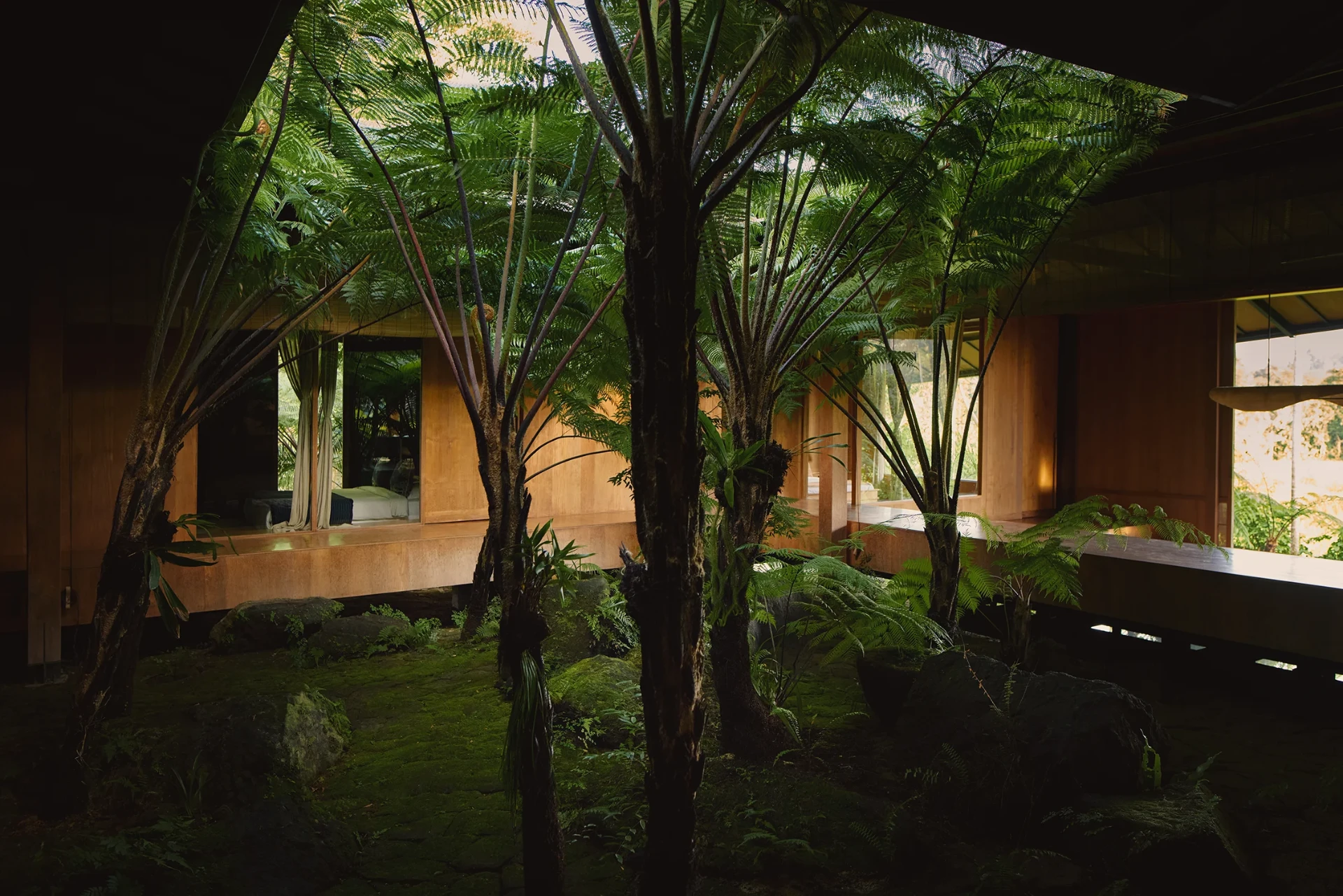
Mesdag’s children flit here and there through the courtyard that has become Kubu Taru’s Axis Mundi, their designated playroom, and the grounds around it. Theirs is a life filled with mindful nurturing and joyful freedom. Nature does not merely surround the home but becomes part of it: the roots of the trees crawl beneath the structure, strengthening its foundation. Here is a quiet symbiosis between Mother Nature and Man. Kubu Taru is a sweet reminder that all human creation starts with what the natural world hands freely.
The land around the house has become a source of life. Bugs are plentiful. Birds come to seek shelter. What was once a monoculture field has been transformed into a space of refuge for all creatures.
Rooms are designed with the Axis Mundi in mind. Mesdag and Blanco took into consideration the right order of each section of the home. It is human to create boundaries, and this natural instinct is present in the geography of Kubu Taru. The terrace is the designated space to greet strangers and acquaintances; the kitchen belongs to friends and family; deeper still, there is a seating section that holds intimate moments.
Intention runs through each choice of material. The structure is made of wood; its interior sparse — recalling Japanese Minimalism — but graceful. Parts of it are dyed with indigo to take on their characteristic blue hue. The ceiling, crafted by Naruse, a Japanese artisan, is made of indigo-dyed banana fibre paper. Small details like these fine-tune the mood of the home, each one deliberate: the stone bath is chiselled by local stonemasons to mimic the natural erosion of the material. The roof rests on its own column, and the roof’s planned asymmetry permits morning and late afternoon light to fall into the interior whilst also protecting those inside from noontide heat. Each detail is practical, not merely pretty. Beyond style, the stilts contain an intelligence that comes from local insight: they lift the structure over the rising damp of the ground and let air circulate more freely. Kubu Taru sees and replies to the beauty that encircles it.
Kubu Taru stands at the intersection of many things, and in doing so underlines the interconnectedness of life. By design, it is intended to be an architecture of safety — not only for the present generation, but also for those to come. In this time of Late-Stage Capitalism, there is a certain looming pressure to always take and take. There is something radical in choosing another way. Kubu Taru, befitting its name, is ultimately a tangible celebration of easy pleasures — the pleasure of sitting and dreaming, of running and playing, of maturing in one’s own time, and of bearing the signs of it with delight.
Text by Jasmine Kusuma